
ICSM Shakespeare in America
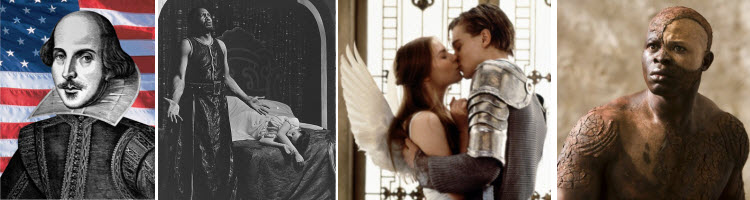
- Paul Robeson as Othello, Guild Theatre, 1943
- Leonardo Dicaprio and Claire Danes, Baz Luhrmann's Romeo and Juliet, 1996
- Djimon Hounsou as Caliban, Julie Taymor's The Tempest, 2010
- Here are the Subject headings most likely to treat Shakespeare's influence, his effect on language, his uses in the classroom, his concept of the New World, and the efforts of people distant in both time and space to adapt his works.
Shakespeare, William, 1564-1616--Adaptations
Shakespeare, William, 1564-1616--Appreciation
Shakespeare, William, 1564-1616--Appreciation--United States
Shakespeare, William, 1564-1616--Appreciation--United States--History
Shakespeare, William, 1564-1616--Film adaptations
Shakespeare, William, 1564-1616--Influence
Shakespeare, William, 1564-1616--Knowledge--America
Shakespeare, William, 1564-1616--Knowledge--Geography
Shakespeare, William, 1564-1616--Language
Shakespeare, William, 1564-1616--Style
Shakespeare, William, 1564-1616--Study and teaching
Shakespeare, William, 1564-1616--Study and teaching--United States
- Stage History will discuss notable events and trends in the production of Shakespeare' s plays, sometimes focusing on American instances.
Shakespeare, William, 1564-1616--Stage history
Shakespeare, William, 1564-1616--Stage history--1625-1800
Shakespeare, William, 1564-1616--Stage history--1800-
Shakespeare, William, 1564-1616--Stage history--1800-1950
Shakespeare, William, 1564-1616--Stage history--Idaho--Bosie
Shakespeare, William, 1564-1616--Stage history--Maryland--Silver Spring
Shakespeare, William, 1564-1616--Stage history--New York (N. Y.)
Shakespeare, William, 1564-1616--Stage history--New York (State)--New York
Shakespeare, William, 1564-1616--Stage history--North America
Shakespeare, William, 1564-1616--Stage history--Oregon
Shakespeare, William, 1564-1616--Stage history--United States
Shakespeare, William, 1564-1616--Stage history--Utah
- Shakespeare criticism is voluminous both for individual plays and the entire corpus--where critical reception is arranged by century.
Shakespeare, William, 1564-1616. Othello
Shakespeare, William, 1564-1616. Romeo and Juliet
Shakespeare, William, 1564-1616. Tempest
Shakespeare, William, 1564-1616--Criticism and interpretation
Shakespeare, William, 1564-1616--Criticism and interpretation--History
Shakespeare, William, 1564-1616--Criticism and interpretation--History--17th century
Shakespeare, William, 1564-1616--Criticism and interpretation--History--18th century
Shakespeare, William, 1564-1616--Criticism and interpretation--History--19th century
Shakespeare, William, 1564-1616--Criticism and interpretation--History--20th century
- General works on 16th and 17th century English theatre will treat the original context and conventions of Shakespeare's theatre, while American theatre history may discuss how these conventions were translated.
Theater--History
Theater--Great Britain--History
Theater--England--History
Theater--England--History--16th century
Theater--England--History--17th century
Theater--England--London--History
Theater--England--London--History--16th century
Theater--England--London--History--17th century
English drama--Early modern and Elizabethan, 1500-1600--History and criticism
English drama--17th century--History and criticism
Theater--United States
Theater--United States--History
Theater--United States--History--18th century
Theater--United States--History--19th century
Theater--United States--History--20th century
Theater and society--United States
Theater and society--United States--History--19th century
African American theater--New York (State)--New York--History--19th century
- Individuals and events relevent to Shakespeare in America may be available as Subject Headings.
Aldridge, Ira Frederick, d. 1867
Brown, William Alexander
Forrest, Edwin, 1806-1872
Macready, William Charles, 1793-1873
Macready, William Charles, 1793-1873--Diaries
Astor Place Riot, New York, N.Y.
Booth, Junius Brutus, 1796-1852
Booth, John Wilkes, 1838-1865
Mercury Theatre on the air (Radio program)
Robeson, Paul, 1898-1976
- Here are Subject Headings that treat how America was perceived and imagined from its discovery and colonization to the present.
America--Discovery and exploration
America--Discovery and exploration--Historiography
North America--Discovery and exploration
North America--History--Colonial period, ca. 1600-1775
America--In literature
English literature--American influences
American literature--English influences
- Here are works that treat the use of drama at various levels of education.
Drama--Study and teaching
Drama in education
Drama in education--United States
Theater--Study and teaching
Theater--Study and teaching--United States
- General works on the language conventions that Shakespare inherited and shaped:
Rhetoric--History--16th century
English language--Early modern, 1500-1700--Rhetoric
English language--Early modern, 1500-1700--Style
- General works on language and literature in America:
English language--United States--History
Books and reading--United States--History
Books and reading--New England--History--17th century
Literature and history--United States
Literature and history--United States--History
Literature and society--United States--History
Literature and society--New England--History--17th century
United States--Civilization--To 1783
United States--Civilization--English influences
MLA International Bibliography provides the most complete and fully indexed coverage of articles and books on modern literatures, linguistics, folklore, rhetoric, and composition from 1925 to the present. There is ample full text provided by ProQuest, as well as links to full-text articles in JSTOR and Project Muse. Full text from other IC databases is also readily available via the "GetIt" links below article citations.
Because books, book chapters/essays, and dissertations will usually not be available full text, you may wish to limit your search to "Journal article" under "Source type."
"Author's Work" and "Author as Subject" will be especially helpful search fields at finding literary criticism. And for additional search field options either click on "Show more fields," or, for the complete list, open the drop-down menus to the right of the "Anywhere" default for the top three rows of search slots. This list includes both "Literary Influence"--who influenced a particular author you have entered--and "Literary Source"--who was influenced by that particular author.
JSTOR has excellent 100% full-text coverage of literary scholarship. There is no Subject searching, so remember to put titles and authors' names in quotation marks to search them as Keyword phrases--and leave authors' names in the normal first-name last-name order. Set "Limit" to "Article"--or else you may unleash an avalanche of reviews of books on your topic.
JSTOR access to journal articles begins 2-4 years prior to the present--so don't look for any criticism from the last couple of years--but coverage always extends back to the first issue of each journal--in some cases into the 19th century and beyond. This allows you, for instance, to retrieve articles referring to or discussing Shakespeare all the way back to 1880. Set the date range "Limit" below the search slots to target an era.
Project Muse , although a smaller database, it complements JSTOR. LIke JSTOR it provides 100% full text of mostly scholarly journals, but its coverage is entirely current--mainly spanning the last 10-15 years. Muse offers a basic keyword search (be sure to put the titles of literary works in quotation marks). Once you've retrieved a set of articles you can sort them into broad categories using the Research Area options on the left.
Note: Checking the "Articles" box under Content Type before you run a search will eliminate reviews of books about your topic and leave you with just the articles on your topic.
ProQuest Research Library & Academic Search Premier are comprehensive databases and include considerable literary criticism--much of it full text. In running searches on authors, don't settle for a Keyword search on the author's name, as this will retrieve too many articles in which the author is only mentioned in passing. Instead use the specialized Subject search each provides. In ProQest enter the name, last name first, in the "Person" slot. In Academic Search Premier open the "Select a Field" drop down menu and search the name, last name first, in the "People" field.
In both databases the titles of literary works must be searched as Keyword phrases, so be sure to put them in quotation marks.
In both databases you can set a "Document Type" limit and choose "Book review" or, if it's a contemporary writer, "Interview." (For a contemporary writer you might also try an "Author" search, since many writers publish criticism and social commentary that might shed light on their creative work.)
Literary Reference Center : The emphasis here is on articles from a wide range of reference resources, including Magill's Survey of American Literature, Cyclopedia of World Literature, Continuum Encyclopedia of British Literature, Masterplots, etc. There is also access to the Critical Insights book series published by Salem Press, each volume dedicated to a single author or a single work. Both the reference works and the Critical Insights series provide very basic biography and interpretation, but these are supplemented by selected scholarly articles.
The simplest approach may be to enter a single author or a particular work in the "Most Studied Authors" or "Most Studied Works" sections of the "Browse" box. An Author or Work record will offer you "Related Information" categories such as "Literary Criticism," "Reference Books," "Biography," and "Plot Summaries."
General OneFile is another comprehensive database with considerable literary criticism, but the default Subject search forcess you to retrieve EVERYTHING on a particular author. The standard "subdivisions" by which General OneFile organizes these results--"Ethical Aspects," Political Aspects," "Social Aspects"--are broad in respect to authors.
If you wish to focus on a particular a theme, the best strategy is to open all the results from the initial Subject search and then use the the "Search within these Results" slot at the upper left to enter thematic Keywords.
If you wish to focus on a specific literary work, open "Advanced Search" and in the "Select Index" box choose "Named Work": this allows you to run a Subject search on a title.
ERIC (Ebsco interface) is an Education database where you can find many scholarly articles on the interpretation and teaching of literary texts at the levels of both secondary and higher education.
New York Times (1851-2009) offers the full text of the New York Times from 1851 up to 2006. Use the "Publication Date" limit below the search slots to enter a specific "Date range" and target articles in, say, the 1860s--the Shakespeare Tercentenary was celebrated in 1864--or any other time period.
Since Shakespeare is so often referred to only by his last name, I recommend searching on the surname rather than on "William Shakespeare"--which would exclude articles where he is referred to only as Shakespeare. This will, however, require you to sort out references to other things named Shakespeare--including things named after Shakespeare but which have nothing much to do with the playwright. Given this problem, you might begin by looking for "Shakespeare" in the "Title" field, then loosen the search by running it in the Abstract" field, and finally the "Anywhere except full text."
Because books, book chapters/essays, and dissertations will usually not be available full text, you may wish to limit your search to "Journal article" under "Source type."
"Author's Work" and "Author as Subject" will be especially helpful search fields at finding literary criticism. And for additional search field options either click on "Show more fields," or, for the complete list, open the drop-down menus to the right of the "Anywhere" default for the top three rows of search slots. This list includes both "Literary Influence"--who influenced a particular author you have entered--and "Literary Source"--who was influenced by that particular author.
JSTOR has excellent 100% full-text coverage of literary scholarship. There is no Subject searching, so remember to put titles and authors' names in quotation marks to search them as Keyword phrases--and leave authors' names in the normal first-name last-name order. Set "Limit" to "Article"--or else you may unleash an avalanche of reviews of books on your topic.
JSTOR access to journal articles begins 2-4 years prior to the present--so don't look for any criticism from the last couple of years--but coverage always extends back to the first issue of each journal--in some cases into the 19th century and beyond. This allows you, for instance, to retrieve articles referring to or discussing Shakespeare all the way back to 1880. Set the date range "Limit" below the search slots to target an era.
Project Muse , although a smaller database, it complements JSTOR. LIke JSTOR it provides 100% full text of mostly scholarly journals, but its coverage is entirely current--mainly spanning the last 10-15 years. Muse offers a basic keyword search (be sure to put the titles of literary works in quotation marks). Once you've retrieved a set of articles you can sort them into broad categories using the Research Area options on the left.
Note: Checking the "Articles" box under Content Type before you run a search will eliminate reviews of books about your topic and leave you with just the articles on your topic.
ProQuest Research Library & Academic Search Premier are comprehensive databases and include considerable literary criticism--much of it full text. In running searches on authors, don't settle for a Keyword search on the author's name, as this will retrieve too many articles in which the author is only mentioned in passing. Instead use the specialized Subject search each provides. In ProQest enter the name, last name first, in the "Person" slot. In Academic Search Premier open the "Select a Field" drop down menu and search the name, last name first, in the "People" field.
In both databases the titles of literary works must be searched as Keyword phrases, so be sure to put them in quotation marks.
In both databases you can set a "Document Type" limit and choose "Book review" or, if it's a contemporary writer, "Interview." (For a contemporary writer you might also try an "Author" search, since many writers publish criticism and social commentary that might shed light on their creative work.)
Literary Reference Center : The emphasis here is on articles from a wide range of reference resources, including Magill's Survey of American Literature, Cyclopedia of World Literature, Continuum Encyclopedia of British Literature, Masterplots, etc. There is also access to the Critical Insights book series published by Salem Press, each volume dedicated to a single author or a single work. Both the reference works and the Critical Insights series provide very basic biography and interpretation, but these are supplemented by selected scholarly articles.
The simplest approach may be to enter a single author or a particular work in the "Most Studied Authors" or "Most Studied Works" sections of the "Browse" box. An Author or Work record will offer you "Related Information" categories such as "Literary Criticism," "Reference Books," "Biography," and "Plot Summaries."
General OneFile is another comprehensive database with considerable literary criticism, but the default Subject search forcess you to retrieve EVERYTHING on a particular author. The standard "subdivisions" by which General OneFile organizes these results--"Ethical Aspects," Political Aspects," "Social Aspects"--are broad in respect to authors.
If you wish to focus on a particular a theme, the best strategy is to open all the results from the initial Subject search and then use the the "Search within these Results" slot at the upper left to enter thematic Keywords.
If you wish to focus on a specific literary work, open "Advanced Search" and in the "Select Index" box choose "Named Work": this allows you to run a Subject search on a title.
ERIC (Ebsco interface) is an Education database where you can find many scholarly articles on the interpretation and teaching of literary texts at the levels of both secondary and higher education.
New York Times (1851-2009) offers the full text of the New York Times from 1851 up to 2006. Use the "Publication Date" limit below the search slots to enter a specific "Date range" and target articles in, say, the 1860s--the Shakespeare Tercentenary was celebrated in 1864--or any other time period.
Since Shakespeare is so often referred to only by his last name, I recommend searching on the surname rather than on "William Shakespeare"--which would exclude articles where he is referred to only as Shakespeare. This will, however, require you to sort out references to other things named Shakespeare--including things named after Shakespeare but which have nothing much to do with the playwright. Given this problem, you might begin by looking for "Shakespeare" in the "Title" field, then loosen the search by running it in the Abstract" field, and finally the "Anywhere except full text."
Few databases offer 100% full text. Most retrieve a mix of full text articles and article "citations"--article title, author(s), publication info, and usually an "abstract" or one-prargraph summary of the content. When a citation makes you want the full text, look below it for this icon:

Clicking "GETIT" checks (almost all) the IC Library's other databases to see if any offers the full text of the article--or if the Library has a print subscription to the journal in which the article appeared.
Clicking "GETIT" checks (almost all) the IC Library's other databases to see if any offers the full text of the article--or if the Library has a print subscription to the journal in which the article appeared.
- "GETIT" will usually find the full text in another database and open it in a new window.
- If none of our databases can access the full text but we have a print subsciption to the journal, "GETIT" will retrieve the Library catalog record for the journal so that you can see if the date of the article falls within the date range we have on hand.
- If full text is not available from any database or from a print subsciption, "GETIT" will provide a link to the IC Library's Interlibrary Loan. Log in (same as your IC e-mail)--and set up your account if you've never used it before. "GETIT" will have populated the article request form with all the necessary information and you simply submit the request elecrtonically. Most articles are supplied as digital files and will be sent to you via e-mail when they arrive.

- Ebrary
- Citation
- Interlibrary Loan
- Plagiarism Tutorial
Note: Log-in required)
- Repositioning Shakespeare : National Formations, Postcolonial Appropriations
- Shakespeare's World/World Shakespeares
- Post-Colonial Shakespeare
- Native Shakespeare : Indigenous Appropriations on a Global Stage
- Shakespeare and Appropriation
- She Hath Been Reading : Women and Shakespeare Clubs in America
- Acting in the Night : Macbeth and the Places of Civil War
- Shakespeare on the American Yiddish Stage
- Shakespeare Inside : The Bard Behind Bars
- Transatlantic Insurrections : British Culture and the Formation of American Literature, 1730-1860
- The importance of feeling English : American literature and the British diaspora, 1750-1850
- History of American Theatre from Its Origins to 1832
- Theatre & the American Nation
- Shakespeare Effect : A History of Twentieth-Century Performance
- Contemporary Shakespeare Production
- Shakespeare and Contemporary Theory : New Historicism and Cultural Materialism
- Shakespeare and Modernity : Early Modern to Millennium
- Screening Shakespeare in the Twenty-First Century
- Shakespeare, from Stage to Screen
- Is Shakespeare Still Our Contemporary?
- Shakespeare and Youth Culture
- Columbus, Shakespeare, and the Interpretation of the New World
- Inventing Americans in the Age of Discovery : Narratives of Encounter
- Engraving the Savage : The New World and Techniques of Civilization
- Shakespeare in Education
- Shakespeare's Schoolroom : Rhetoric, Discipline, Emotion
- Othello and Interpretive Traditions
- Tempest in the Caribbean
- This England, That Shakespeare : New Angles on Englishness and the Bard
- Quoting Shakespeare : Form & Culture in Early Modern Drama
- Voice of the Shuttle: English Literature: Renaissance & 17th Century : An excellent gateway to Web resources, if a bit sprawling. The main categories here are "General Resources," "Authors and Works" (alphabetical by author), and "Cultural and Historical Contexts."
- Luminarium: A very elegant site with easy access to both the primary works and selected secondary ciriticism. The Shakespeare link in the Renaissance section connects you to the now defunct Mr. William Shakespeare and the Internet site (for an archived version, see link below), but take a look at the outstanding "Renaissance Resources." Also be sure to visit the "Luminarium Encyclopedia"--a work in progress.
- Early Modern Literary Studies: A scholarly journal on the literature and culture of the 16th and 17th centuries, with all the articles avialable full text. The "Search EMLS" interface is only a single Keyword slot, but it's easy to target either criticism or e-texts.
- Mr William Shakespeare & the Internet: This was the best all-purpose gateway to Shakespeare resources on the Web, but it was retired in 2013. The link above is to an Internet Archive copy of the site made just before it was taken down. Many links are now broken, but there is still a good deal of accessible content.
- Internet Shakespeare Editions: Texts, context, and criticism.
- Absolute Shakespeare: Scan-and-click access to the Bard.
- Shakespeare Online Pretty good gateway from Amanda Mabillard. Note especially her Shakespeare Timeline.
- Shakespeare Resource Center Nothing very sophisticated at this student-research oriented site, but some useful links, well organized.
- MIT Global Shakespeare "Providing online access to performances of Shakespeare from many parts of the world as well as essays and metadata by scholars and educators in the field." In paticular see the Essays & Interviews.
- Shakespeare's Globe Web site of the new Globe Theatre. See in particular the Papers and Research section.
- Works of the Bard (online concordance): User preference divides between this digital archive of Shakespeare's works and the Complete Works of William Shakespeare from MIT, but despite MIT's cleaner design, this site is slightly more complete and has a better search engine powering its oncordance.
- William Shakespeare in America: This is an excerpt from Highbrow/Lowbrow: The Emergence of Cultural Hierarchy in America by Lawrence Levine--an academic historian.
- Shakespeare in America This is an interview with James Shapiro, author of a recent book by this title.
- Shakespeare in American Life: Resources from the Folger Shakespeare Library.
- African Americans and Shakespeare: A podcast from the Folger Shakespeare Library.
MLA is the citation style used by most disciplines in the Humanities. The guides below use the latest 2008/9 standards.
