
ICSM Writing (as) Technology: Identity & Inscription in the Digital Age
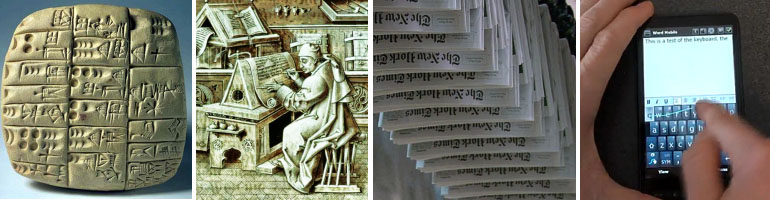
Best Bet Database: General OneFile : Try a Subject search on Instant Messaging or Email or Twitter and open the "Subdivisions" to target an aspect: Economic aspects, History, Innovations, Social aspects, etc. Or try Writing and look at --Technology application.
Writing--History
Authorship--History
Transmission of texts
Alphabets
Manuscripts (Papyri)
Books and reading--Greece
Literacy--Greece
Manuscripts, Medieval
Gutenberg, Johann, 1397?-1468
Books--History
Printing--History
Books and reading--History
Printing--Europe--History
Books and reading--Great Britain
Printing--Great Britain--History
Literacy--Great Britain
Books and reading--United States--History--19th century
Books and reading--United States--History--20th century
Printing--United States--History
Books--Social aspects
Printing--Social aspects
Publishers and publishing
Publishers and publishing--Great Britain
Publishers and publishing--United States
Publishers and publishing--United States--History--20th century
Electronic publishing
Electronic publishing--United States
Internet publishing
Written communication
Written communication--Social aspects
Written communication--Technological innovations
Hypertext systems
(Odd though this next group may sound, it's where you'll find a good many of our resources on writing for electronic media.)
English language--Computer-assisted instruction
English language--Rhetoric--Study and teaching--Data processing
English language--Rhetoric--Computer-assisted instruction
English language--Rhetoric--Study and teaching--Technological innovations
Report writing--Computer-assisted instruction
Report writing--Study and teaching--Data processing
Electronic portfolios in education
Online social networks
Online social networks--Social aspects
Online social networks--United States
Online chat groups--Social aspects
Electronic discussion groups--Social aspects
Facebook (Electronic resource)
Twitter
Text messages (Telephone systems)
Instant messaging
Electronic mail messages
Electronic mail systems--Social aspects
Blogs
Blogs--Social aspects
Online authorship
Language and the Internet
Written communication--Technological innovations
Computers and literacy
Technological literacy
Internet literacy
Media literacy
Communication and technology
Communication--Technological innovations
Communication--Technological innovations--Social aspects
Interpersonal communication--Technological innovations--Social aspects
Social interaction--Technological innovations
Technological innovations--Social aspects
Authorship--History
Transmission of texts
Alphabets
Manuscripts (Papyri)
Books and reading--Greece
Literacy--Greece
Manuscripts, Medieval
Gutenberg, Johann, 1397?-1468
Books--History
Printing--History
Books and reading--History
Printing--Europe--History
Books and reading--Great Britain
Printing--Great Britain--History
Literacy--Great Britain
Books and reading--United States--History--19th century
Books and reading--United States--History--20th century
Printing--United States--History
Books--Social aspects
Printing--Social aspects
Publishers and publishing
Publishers and publishing--Great Britain
Publishers and publishing--United States
Publishers and publishing--United States--History--20th century
Electronic publishing
Electronic publishing--United States
Internet publishing
Written communication
Written communication--Social aspects
Written communication--Technological innovations
Hypertext systems
(Odd though this next group may sound, it's where you'll find a good many of our resources on writing for electronic media.)
English language--Computer-assisted instruction
English language--Rhetoric--Study and teaching--Data processing
English language--Rhetoric--Computer-assisted instruction
English language--Rhetoric--Study and teaching--Technological innovations
Report writing--Computer-assisted instruction
Report writing--Study and teaching--Data processing
Electronic portfolios in education
Online social networks
Online social networks--Social aspects
Online social networks--United States
Online chat groups--Social aspects
Electronic discussion groups--Social aspects
Facebook (Electronic resource)
Text messages (Telephone systems)
Instant messaging
Electronic mail messages
Electronic mail systems--Social aspects
Blogs
Blogs--Social aspects
Online authorship
Language and the Internet
Written communication--Technological innovations
Computers and literacy
Technological literacy
Internet literacy
Media literacy
Communication and technology
Communication--Technological innovations
Communication--Technological innovations--Social aspects
Interpersonal communication--Technological innovations--Social aspects
Social interaction--Technological innovations
Technological innovations--Social aspects
General OneFile : is the most user-friendly of our comprehensive databases, covering almost any topic from a wide range of disciplinary angles and offering lots of full text. Use the default Subject search to find the best subject heading for your topic (and when you find a good one be sure to look at the "Related Subjects" to see if there's something even better).
When you settle on a subject heading, open the "Subdivisions" link below it. Most General OneFile subject searchs produce very large retrievals and the "subdivisions" help you narrow your search to a particular aspect: "Ethical aspects," "Forecasts and Trends," "History," "Political aspects," "Psychological aspects," and "Social aspects," to name only a few.
If the best available subdivision is still too broad, open it and add your own Keywords in the "Search within these results" slot at the upper left.
User Advisory: When first viewing your retrievals in General OneFile, note that you are seeing only the "Magazines" (popular articles) and must click on the tabs for "Academic Journals" (scholarly articles) or "News" (newspaper articles) to see those results
Academic Search Premier Comprehensive subject coverage with considerable full text. Note that there is a “Subject Terms” link just above the search boxes, allowing you to search the index of Subject Headings--often a good first stop for more efficient Subject searching whereby you are guaranteed that your topic is indeed a main subject of the articles retrieved.
When you settle on a subject heading, open the "Subdivisions" link below it. Most General OneFile subject searchs produce very large retrievals and the "subdivisions" help you narrow your search to a particular aspect: "Ethical aspects," "Forecasts and Trends," "History," "Political aspects," "Psychological aspects," and "Social aspects," to name only a few.
If the best available subdivision is still too broad, open it and add your own Keywords in the "Search within these results" slot at the upper left.
User Advisory: When first viewing your retrievals in General OneFile, note that you are seeing only the "Magazines" (popular articles) and must click on the tabs for "Academic Journals" (scholarly articles) or "News" (newspaper articles) to see those results
Academic Search Premier Comprehensive subject coverage with considerable full text. Note that there is a “Subject Terms” link just above the search boxes, allowing you to search the index of Subject Headings--often a good first stop for more efficient Subject searching whereby you are guaranteed that your topic is indeed a main subject of the articles retrieved.
A good initial strategy in this database is to search a likely topic in the Subject Terms and when you find it “explode” the term by double clicking it--this brings up a list of related Subject terms. You can check as many terms as you like before "adding" them to your search by AND-ing or OR-ing them together.
User Advisory: For any retrieved set of articles, there will be a box displayed on the left that will limit the articles to “Scholarly” journals—just check the box and click the “Update Results” button below.
ProQuest Research Library is another comprehensive database with substantial full text. Use the "Thesaurus" (above the search slots) to preview what Subject Headings are available.
Note that to the right of your search results you can limit your retrieval by "Source Type" (including Magazines, Newspapers, Scholarly Journals), "Document Type," (including Cover Story, Editorial, or Interview), and "Location."
Above each set of articles you retrieve ProQuest will display related Subject searches to help either broaden or narrow your focus.
PsycINFO : The American Psychological Association use their own Subject vocabulary (called "Descriptors"), so a visit to the "Thesaurus" above the search slots is usually a good idea--but unfortunately there is no Subject Heading for "conspiracy" or "conspiracy theories" here. Both will work as keywords, however, and retrieve dozens of articles.
PsycINFO deals only with scholarly literature, much of it assuming a graduate-level understanding of the discipline. But among these you may find interesting, accessible articles on your topic.
User Advisory: If what you're searching for are "journals" in "English," it's a good idea to check those boxes below the search slots.
ERIC (Ebsco interface) : A disciplinary database in Education—at all levels. The field of Education has its own set of Subject Headings so be sure to browse the “Thesaurus” (above the search slots) for the best "Descriptors." ERIC provides access not only to relevant journal literature (citations for these end in a number preceded by EJ—ERIC Journal), but also to research published directly to ERIC (citations for these end in a number preceded by ED—ERIC Document.
JSTOR : covers a wide range of scholarly journals in most disciiplines, always beginning with the first issue of each one. This provides 100% full text access to articles from not only the first half of the 20th century but even the second half of the 19th. Be aware, however, that at the other end of the date range articles don't appear in JSTOR until at least 1-2 years after publication.
JSTOR offers only a Keyword search of its complete full text, so retrievals are large, but the relevancy ranking does a good job of putting the strongest matches on the first few pages. This relevancy ranking does not weigh date, however, and will display a mix of articles written decades apart. So if your topic is time sensitive, be alert to publication dates.
User Advisory: The academic journals covered here feature numerous book reviews, so it's a good idea to tic the "Article" limit below the search slots so you won't be overwhelmed by book reviews on your topic.
Project Muse , although a smaller database, it complements JSTOR. LIke JSTOR it provides 100% full text of mostly scholarly journals, but its coverage is entirely current--mainly spanning the last 10-15 years. Muse offers a basic keyword search (be sure to put the titles of literary works in quotation marks). Once you've retrieved a set of articles you can sort them into broad categories using the Research Area options on the left.
Note: Checking the "Articles" box under Content Type before you run a search will eliminate reviews of books about your topic and leave you with just the articles on your topic.
MLA International Bibliography provides the most complete and fully indexed coverage of articles and books on modern literatures, linguistics, folklore, rhetoric, and composition from 1925 to the present. There is ample full text provided by ProQuest, as well as links to full-text articles in JSTOR and Project Muse. Full text from other IC databases is also readily available via the "GetIt" links below article citations.
Because books, book chapters/essays, and dissertations will usually not be available full text, you may wish to limit your search to "Journal article" under "Source type."
"Author's Work" and "Author as Subject" will be especially helpful search fields at finding literary criticism. And for additional search field options either click on "Show more fields," or, for the complete list, open the drop-down menus to the right of the "Anywhere" default for the top three rows of search slots. This list includes both "Literary Influence"--who influenced a particular author you have entered--and "Literary Source"--who was influenced by that particular author.
If you set up a free "My Research" account with Proquest (top right), you can save all the articles you check, all the searches you want to remember, and set up e-mail or RSS notification for any new articles that match your search terms.
ProQuest Research Library is another comprehensive database with substantial full text. Use the "Thesaurus" (above the search slots) to preview what Subject Headings are available.
Note that to the right of your search results you can limit your retrieval by "Source Type" (including Magazines, Newspapers, Scholarly Journals), "Document Type," (including Cover Story, Editorial, or Interview), and "Location."
Above each set of articles you retrieve ProQuest will display related Subject searches to help either broaden or narrow your focus.
PsycINFO : The American Psychological Association use their own Subject vocabulary (called "Descriptors"), so a visit to the "Thesaurus" above the search slots is usually a good idea--but unfortunately there is no Subject Heading for "conspiracy" or "conspiracy theories" here. Both will work as keywords, however, and retrieve dozens of articles.
PsycINFO deals only with scholarly literature, much of it assuming a graduate-level understanding of the discipline. But among these you may find interesting, accessible articles on your topic.
User Advisory: If what you're searching for are "journals" in "English," it's a good idea to check those boxes below the search slots.
ERIC (Ebsco interface) : A disciplinary database in Education—at all levels. The field of Education has its own set of Subject Headings so be sure to browse the “Thesaurus” (above the search slots) for the best "Descriptors." ERIC provides access not only to relevant journal literature (citations for these end in a number preceded by EJ—ERIC Journal), but also to research published directly to ERIC (citations for these end in a number preceded by ED—ERIC Document.
Education uses its own Subject Headings, so a useful first stop is the ERIC "Thesaurus" (above the search slots) to see what Subject searches will work here. This is also a helpful exercise in that once you have found the appropriate Subject Heading you can "explode" it (double click) and generate a list of related Subject Headings.
JSTOR : covers a wide range of scholarly journals in most disciiplines, always beginning with the first issue of each one. This provides 100% full text access to articles from not only the first half of the 20th century but even the second half of the 19th. Be aware, however, that at the other end of the date range articles don't appear in JSTOR until at least 1-2 years after publication.
JSTOR offers only a Keyword search of its complete full text, so retrievals are large, but the relevancy ranking does a good job of putting the strongest matches on the first few pages. This relevancy ranking does not weigh date, however, and will display a mix of articles written decades apart. So if your topic is time sensitive, be alert to publication dates.
User Advisory: The academic journals covered here feature numerous book reviews, so it's a good idea to tic the "Article" limit below the search slots so you won't be overwhelmed by book reviews on your topic.
Project Muse , although a smaller database, it complements JSTOR. LIke JSTOR it provides 100% full text of mostly scholarly journals, but its coverage is entirely current--mainly spanning the last 10-15 years. Muse offers a basic keyword search (be sure to put the titles of literary works in quotation marks). Once you've retrieved a set of articles you can sort them into broad categories using the Research Area options on the left.
Note: Checking the "Articles" box under Content Type before you run a search will eliminate reviews of books about your topic and leave you with just the articles on your topic.
MLA International Bibliography provides the most complete and fully indexed coverage of articles and books on modern literatures, linguistics, folklore, rhetoric, and composition from 1925 to the present. There is ample full text provided by ProQuest, as well as links to full-text articles in JSTOR and Project Muse. Full text from other IC databases is also readily available via the "GetIt" links below article citations.
Because books, book chapters/essays, and dissertations will usually not be available full text, you may wish to limit your search to "Journal article" under "Source type."
"Author's Work" and "Author as Subject" will be especially helpful search fields at finding literary criticism. And for additional search field options either click on "Show more fields," or, for the complete list, open the drop-down menus to the right of the "Anywhere" default for the top three rows of search slots. This list includes both "Literary Influence"--who influenced a particular author you have entered--and "Literary Source"--who was influenced by that particular author.
If you set up a free "My Research" account with Proquest (top right), you can save all the articles you check, all the searches you want to remember, and set up e-mail or RSS notification for any new articles that match your search terms.
Few databases offer 100% full text. Most retrieve a mix of full text articles and article "citations"--article title, author(s), publication info, and usually an "abstract" or one-prargraph summary of the content. When a citation makes you want the full text, look below it for this icon:

Clicking "GETIT" checks (almost all) the IC Library's other databases to see if any offers the full text of the article--or if the Library has a print subscription to the journal in which the article appeared.
Clicking "GETIT" checks (almost all) the IC Library's other databases to see if any offers the full text of the article--or if the Library has a print subscription to the journal in which the article appeared.
- "GETIT" will usually find the full text in another database and open it in a new window.
- If none of our databases can access the full text but we have a print subsciption to the journal, "GETIT" will retrieve the Library catalog record for the journal so that you can see if the date of the article falls within the date range we have on hand.
- If full text is not available from any database or from a print subsciption, "GETIT" will provide a link to the IC Library's Interlibrary Loan. Log in (same as your IC e-mail)--and set up your account if you've never used it before. "GETIT" will have populated the article request form with all the necessary information and you simply submit the request elecrtonically. Most articles are supplied as digital files and will be sent to you via e-mail when they arrive.

- Ebrary
- Citation
- Interlibrary Loan
- Plagiarism Tutorial
(login required: IC email name/password)
- Writing Revolution : Cuneiform to the Internet
- Renaissance Computer : Knowledge Technology in the First Age of Print
- English in Print : From Caxton to Shakespeare to Milton
- Material Texts : Out of Sorts : On Typography and Print Culture
- Twilight of the Literary : Figures of Thought in the Age of Print
- Case for Books : Past, Present, and Future
- Late Age of Print : Everday Book Culture from Consumerism to Control
- Better Pencil : Readers, Writers, and the Digital Revolution
- Publishing as a Vocation : Studies of an Old Occupation in a New Technological Era
- No Shelf Required : E-Books in Libraries
- Books, Bytes and Business : The Promise of Digital Publishing
- Text Editing, Print and the Digital World
- Enhanced Publications : Linking Publications and Research Data in Digital Repositories
- Internet Publishing & Beyond
- Beyond Semiotics : Text, Culture and Technology
- Parchment, Paper, Pixels : Law and the Technologies of Communication
- Language and the Internet
- Always On : Language in an Online and Mobile World
- Rhetorics and Technologies : New Directions in Communication
- Txtng : The Gr8 Db8
- Better Pencil : Readers, Writers, and the Digital Revolution
- Sign Here! : Handwriting in the Age of New Media
- Discourse of Blogs and Wikis
- Wiki Writing : Collaborative Learning in the College Classroom
- Rhetorical Delivery as Technological Discourse : A Cross-Historical Study
- New Media Poetics : Contexts, Technotexts, and Theories
- Electronic Literature : New Horizons for the Literary
- New Narratives : Stories and Storytelling in the Digital Age
- Literary Art in Digital Performance : Case Studies in New Media Art and Criticism
- Virtual Words : Language from the Edge of Science and Technology
- Writing, Technology, and Teens: A 2008 Pew Research report which is still among the most cited research on the subject.
- "Writers, Technology, and the Future": 2012 article from the Wilson Quaterly.
- How We Will Read: A fascinating series of interviews with publishers, wirters, and intellectuals exploring the furture of books.
- The Future of Reading: 2010 symposium held at the Rochester Institute of Technology. This home page links you to both videos of the speakers/panels and print summaries.
- Unbound: Speculations on the Future of the Book: A conference held at the Boston Athenaeum in 2012, this site includes videos of the speakers and panel discussions as well as a series of related articles at the bottom.
- History of the Book: Time-Table covering 3500 BCE--1997.
- Institute for the Future of the Book: Worth poking around in the "Projects" and "If:Book" blog of this think tank.
- Scenarios for the Future of the Book: A scholar on the history of the book prepared this 2012 report for the American Library Association.
- "What Will Become of the Paper Book?" 2012 article from e-zine Slate (may take a while to load).
- Smell of Books: Books, Technology, and Future Think: Interesting blog by an editor/publisher.
- "Self-publishing is the Future — and Great for Writers": 2013 article from e-zine Salon.
- Write or Wrong: Does Technology Benefit the Writing Process?: University of Minnesota first-year writing students blog from 2009.
- Electronic Literature Directory: Resources: "Both a repository of works and a critical companion to e-literature," most articles here are linked to full text.
- Writer's Web: Writing Online: Basic tips site from the University of Richmond.
MLA is the citation style used by most disciplines in the Humanities. The guides below use the latest 2008/9 standards.
