
FAQs (click to expand)
Yes, we do -- we have all current volumes of the Orchestral Musician's CD-ROM Library available in the library.
There is also a self-serve color printer/copier on the main floor of the Library, located to the right of the Circulation Desk.
It can print PDF, JPG or TIFF formats from a flashdrive, as well as black and white, for 30 cents a copy. To print in color, follow these steps:
- Select "Media Print Text" from the Home menu
- Insert your USB flash drive. If there are a lot of files, this process may take a few minutes.
- Select from the list either a folder or a file.
- Press Save and select the paper size.
- Next, put the correct coinage in the coin box and press the green copy button.
During a typical academic year, there are approximately 2800 undergraduate and 450 graduate courses taught at IC. Using 3 texts as the average required for each course, this equals approximately 9750 books. Also, textbooks tend to be frequently updated.
In recent academic years, the Library budget has allowed for the purchase approximately 5,800 new books and ebooks to support the current research needs of all departments and programs on campus.
We do not have the funds to purchase current textbooks, while at the same time supporting student and faculty research needs.
Faculty sometimes place copies of textbooks or chapters from texts on reserve or ereserve. If you’re not sure whether your professor has put your course’s textbook on reserve, search the Reserves site to see what is available.
Please note that, as academic libraries generally do not purchase textbooks, they are not available on interlibrary loan. The IC Library does not fill Interlibrary Loan requests for textbooks in current use at the College.
The Ithaca College Bookstore provides a rental service and sells textbooks. Additional rental/purchase sites:
Amazon (also rents textbooks)
Bigwords.com
BookLookr
BooksPrice
BookRenter
BookSpot: Textbooks
CampusBookRentals.com
CengageBrain
Chegg
CollegeBookRenter.com
Half.com
Open Access Textbooks
OpenStax College
PickTextBooks
SlugBooks
Textbookspy
The Saylor Foundation has opened its Media Library to the public, providing thousands of open educational resources, videos, articles, and full-length textbooks.
Nonetheless, before you wait until the last minute to start working on a research assignment, consider these factors:
- There are only limited sources in the library.
- Computers are in short supply, and macines, printers, internet connections, and networks all break down.
- Most things take longer than you think and it is easy to underestimate the time that the mechanics of doing research takes.
- Interlibrary loan can provide you with materials not available in the library, but it might take 48 hours or more (but sometimes less) to acquire them.
- Ideas improve with age. It takes time just to read, but even more time to think about and evaluate what you have read. A final draft is always better if it is not also the first draft.
- Keep track of your deadlines and know when assignments are due.
- Prioritize assignments by both due date and importance.
- Don't put off learning ways to conquer procrastination.
- Try not to be distracted. Turn off the cell phone. Swear off texting for the day.
- Don't underestimate how much time all the little things will take in order to get the big things done.
- Don't try to do too much in one take. Schedule yourself some multiple times to work on a single assignment.
- Learn from previous experience and try to remember.
- Sometimes they have immediate answers or might be able to lower your frustration.
- They know how the system works. They know where things are located, even some things that seem hidden to everyone else.
- Reference librarians know some short cuts.
- They can recommend good, even the best, research tools to use.
- They know the jargon of research.
- They probably have worked with your professor before and know the assignment.
- But please remember: Help takes time. Librarians, too, are limited by time and can become frustrated themselves when a student replies with the fatal words, "but I need it by tomorrow."
- The Safety & Accessibility Map shows power door access to campus buildings, parking lots, also blue light phones & defibrillators
- The pocket-size Ithaca Campus Map (available at the Campus Center, Admission Office, Library Reference Desk, Safety Office, etc.) also provides this information
- Detailed accessibility information for each building is provided on the Accessibility Guide (entrances, elevator if any, handicapped-accessible bathrooms, listening devices) & also at the door to each building
If you are looking for peer reviewed articles, one way is to limit your database searches to only articles in peer reviewed publications. Many databases allow you to do this. For example, most EBSCO databases have a box labeled "Scholarly" or "Peer Reviewed" in the limiters section under the main search boxes.
- Past Worlds: Atlas of Archaeology has maps, illustrations, and some supportive text. REF G 1046 E15 P3 1988
- The venerable 12 volume set Cambridge Ancient History, published in the 1920s. REF D 57 C25
- The 3d edition of the Cambridge Ancient History (1970) was shorted to four volumes. REF D 57 C252
- Greenwood Encyclopedia of Daily Life, Volume 1: the Ancient World, which is kind of cheesy but gives short overviews of different regions in a variety of aspects of life. REF GT 31 G74 2004
- Also in reference are some geographical based historical encyclopedias on Africa, Asia, Europe, America, and elsewhere that include ancient time periods.
There are many books in the Ithaca College Library collection that should not only give you a good starting place, but may overwhelm you with information on your topic. When you are searching the online catalog, don't start with the word Archaeology. That will lead you mostly to books on the discipline of archaeology. When the subject is the archaeology of a particular place, the best subject headings to explore will begin with the name of the country, region, or other place. Subheading that will be most relevant include Antiquities, Civilization (especially followed by "To [some early date]," and History (especially followed by "To [some early date]."
Be careful of geographic names. Use both the names of regions and of countries. Since the names of countries have changed frequently over the centuries, avoid the use of modern names. Use Korea, for example, not Korea (South) or Korea (North), when exploring any topic before 1945.
Examine these examples for ideas:
- For the research on ancient Middle East, try MIDDLE EAST -- ANTIQUITIES, MIDDLE EAST -- CIVILIZATION -- TO 634, and MIDDLE EAST -- HISTORY -- TO 634.
- For resources on life during the earliest time periods in Ireland, you might try IRELAND -- ANTIQUITIES, IRELAND -- CIVILIZATION -- TO 1172, and IRELAND --- HISTORY -- TO 1172.
- For the archaeology of ancient China, try CHINA -- ANTIQUITIES, CHINA -- CIVILIZATION -- TO 221 B.C., and CHINA --- HISTORY -- TO 221 B.C.
- For Mayan civilization and archaeology, use as broad a heading as MAYAS -- ANTIQUITIES or as narrow a heading as MAYAS -- MEXICO - SOCONUSCO REGION -- ANTIQUITIES.
- For archaeological digs in Peru, use EXCAVATIONS (ARCHAEOLOGY) -- ANDES and EXCAVATIONS (ARCHAEOLOGY) -- PERU
Due to copyright restrictions, all region 2-6 DVDs owned by the Library are part of the Core Collection.
PAL DVDs can also be viewed using any computer. Headphones are available at the Circulation/Reserve Desk if viewing in the Library.
For photos of artwork, include the book's publication information of the text in which the image appears.
A label and title or caption ordinarily appear directly below the illustration and have the same one-inch margins as the text of the paper.
Captions should be numbered consecutively
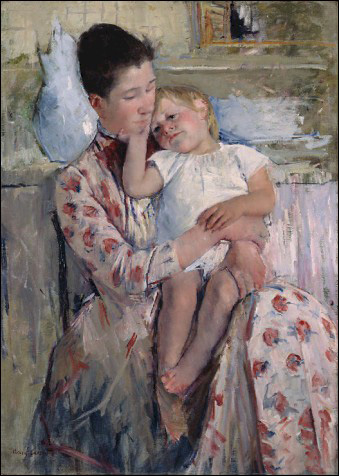
Fig. 1. Mary Cassatt, Mother and Child, Wichita Art Museum. Illus. in Novelene Ross, Toward an American Identity: Selections from the Wichita Art Museum Collection of American Art (Wichita, Kansas: Wichita Art Museum, 1997) 107.
Source: Gibaldi, Joseph. MLA Handbook for Writers of Research Papers. 7th ed. New York: Modern Language Association of America, 2009.
You wish to cite a source you know only through quotation in another source. For example, in Charles L. Griswold's book Forgiveness: A Philosophical Exploration you encounter a quotation you would like to use: "Dori Laub argues in his study of Holocaust testimonials that 'there is, in each survivor, an imperative need to tell and thus to come to know one's story.'" You wish to use the Laub quote, but you cannot locate the original article that Griswold cites.
APA:
Dori Laub maintains that "there is, in each survivor, an imperative need to tell and thus to come to know one's story" (as cited in Griswold, 2007, p. 106).
This would be accompanied by a full citation for the Griswold book in your References:
Griswold, C. L. (2007). Forgiveness: A philosophical exploration. Cambridge, England: Cambridge University Press.
see Publication Manual of the APA (6th ed.), section 6.17
MLA:
Dori Laub maintains that 'there is, in each survivor, an imperative need to tell and thus to come to know one's story" (qtd. in Griswold 106).
This would be accompanied by a full citation for the Griswold book in your Works Cited:
Griswold, Charles L. Forgiveness: A Philosophical Exploration. Cambridge: Cambridge UP, 2007.
see MLA Handbook (7th ed.), p. section 6.4.7
Many of the library's subject research guides have a primary source category, for instance:
- History Research: United States - Primary Sources
- Journalism Research: Primary Sources
- Law Research: Primary Sources
- Check, money order, or ID Express at the Circulation Desk.
- Cash may be added to your ID Express acccount using the Value Added machine, which is located to the right of the copiers on the main floor.
- Cash may be used at the Office of Student Financial Services, or the Casheiring Window located in the Campus Center; the Library can transfer fines upon your request.
- Unpaid fines/fees are automatically billed to the Office of Student Financial Services after 30 days. All charges are non-refundable after this point.
- IC Affiliate and Staff fines/fees not paid within 30 days will be sent to Financial Services for collection at which point they will be non-refundable.
There are approximately 75 desktop PCs in the Library , 21 laptops and 2 iPads that can be borrowed for 6-hour use in the Library. Laptops can be checked out at the Circulation Desk. We also check out cords to connect laptops with power outlets. The desktop PCs are located in the following areas:
- on the 3rd floor - along the north (Lake) side
- in Room 319
- in the Multimedia Listening area
- clustered around the pillars on the Main (2nd) Floor
If an item has been renewed twice and is still needed, please contact staff at either the Circulation or Multimedia Services Desk.
See the Circulation Policy for more information.
Please see the Writing and Citing guide for help with MLA, APA, and other formats.
- Divakaran, A. (2008). Multimedia Content Analysis: Theory and Applications. Springer.
- Fortunato, J. A. (2005). Making Media Content: The Influence of Constituency Groups on Mass Media. Mahwah, N.J: Lawrence Erlbaum Associates.
- Krippendorff, K. (2004). Content Analysis: An Introduction to Its Methodology (2nd ed.). Thousand Oaks, Calif: Sage.
- Krippendorff, K. (2008). Content Analysis Reader. Sage Publications.
- Message Effects in Communication Science. (1989). Sage annual reviews of communication research. Newbury Park, Calif: Sage Publications.
- Neuendorf, K. A. (2002). The Content Analysis Guidebook. Thousand Oaks, Calif: Sage Publications.
- Postman, N. (2008). How to Watch TV News (Rev. ed.). New York, N.Y: Penguin.
- Riffe, D. (2005). Analyzing Media Messages: Using Quantitative Content Analysis in Research (2nd ed.). Mahwah, N.J: Lawrence Erlbaum.
Color printing is available from any library desktop computer; .30 cents per single side, or .56 cents for double-sided. Select File -> Print -. librarycolor.
The Library has a color printer / copier, located on the main floor of the Library. It prints PDF, JPG, and TIFF files - the charge is 30 cents per copy. If you need to print a Word or Powerpoint file, convert it to PDF first.
The Center for Print Production, located in the Public Safety/General Services Building (open M-F 8am-4 pm) provides large format printing and laminating. Jobs may be submitted through WebCRD, and picked up at the Library during open hours.
Not to be confused with the main Google search engine, are two related Google search tools that can be good resources for research.
Google Books is a collection of books in the public domain that Google, in cooperation with several large university libraries, has scanned. Because of copyright laws, only books for which there is no copyright protection are fully accessible. That means, in most cases, the materials are more than seventy years old. For some topics this is not a problem; for others it is pretty useless. You can specifically search Google Books, but a regular Google search will include Google Books result mixed in the list.
Google Scholar is a separate search engine for a broad range of research areas. Google Scholar competes with some commercial periodical databases and includes some features not included in some others, such as citation searching. In addition to peer-reviewed journal articles, records will include preprints, and technical reports. Results of a Google Scholar search will include Google Books records. Each Google search citation will include a link to the full-text resource provided by the IC Library, when available, but if you click the wrong hyperlink, you may bypass the library connection and be asked to pay to view an article.
Overdue fines are charged for:
*Interlibrary loan items
*Multimedia items
*Recalled and special permission items
Items not returned within fourteen days of their due dates are charged the replacement cost; hourly loan items, such as laptops, are billed one day after their due dates. The replacement cost is waived if the item is returned within thirty days. After that time, charges are sent to the Office of Student Financial Services and are non-refundable.
For more information, please see the Circulation Policy.
There will be no cost to your organization as long as the Library holds Public Performance Rights and the showing is free and limited to the Ithaca College community. If the Library does not hold Public Performance Rights, we can provide you contact information in order to obtain it.
If you've already renewed, reply to the courtesy/overdue email and let us know the situation. We'll do our best to help you upon reviewing the situation.
Renewal limits and fines will waived in the case of a verifiable family or individual health emergency, or a required appearance in a court of law in accordance with Ithaca College's Attendance Policy.
You will find empirical studies in scholarly journals, not popular magazines.
For students : Click on this optoin to have an item retrieved from the library stacks and held for you at the Circulation/Multimedia desk; items are held for 72 hours.
For Recall : If the item is checked out, click on this option to recall it. Recalling the item makes it due back in three weeks or the original due date, whichever occurs first.
Journal articles and book chapters may be requested through Interlibrary loan; you will be sent an e-mail with a link to the PDF.
If a book from the Library's collection is needed, send e-mail to [email protected] along with the title of the item, your name, and current address.
If a book is needed that is not in the Library's collection, please contact the Research Help Desk for assistance.
Due to licensing agreements, material in DVD or CD formats must be checked out at the Ithaca College Library. Please contact the Research Help Desk for assistance with media needs.
* Bluetooth keyboard
* Calculators
* Dell laptops
* External CD/DVD drive
* External microphones
* Headphones/Headsets
* HD video camera/recorders - 7 day loan
* iPads (geneation 1 and 2)
* iPad chargers
* iPhone chargers
* Mac book
* Power strips/extension cords
* USB web cam
- Current/previous courses are listed in the HomerConnect Class Schedule
- Current courses in the School of H&S; are on the Web here
- Current courses in the School of HSHP are on the Web here
- Courses offered year by year (undergrad, grad) are at College Catalogs
- The College Archives (Library 5th floor) has print copies of catalogs
The Ithaca College Library subscribes to many different newspaper databases and periodical databases that index newspapers:
- LexisNexis Academic over 1,00 fulltext newspapers from around the world
- InfoTrac Newsstand (Gale) 900 newspapers, national and international
- National Newspapers Premier (ProQuest) 54 newspapers, but only some indexed through to the present.
- Newspaper Source (EBSCO) 25 national and international newspapers plus tv and radio transcipts
- ProQuest newspapers 32 newspapers
- New York Times (1851-2007)
- Wall Street Journal (1889-1991)
- Chronicling America: Historic American Newspapers (Library of Congress)
- Journalism (broad subject guide)
- Journalism History
- eReference
Search the Market Research Library provided by the U.S. Commercial Service. database. It includes the current and historical international trade statistics (imports and exports), announcements of trade opportunities and market analysis. Included are the Best Market Reports, Country Commercial Guides and Market Research Reports.
Search the Trade Statistics page found at Business.gov
Trade Data and Analysis from Export.gov . Includes import/export figures, by country/commodity and analysis by industry sector.
See also our Finding Scholarships webpage for a list of resources.
Also, please speak to the folks in Ithaca College's Office of Student Financial Services (located in Peggy Ryan Williams Center ) (607) 274-3131
Institutional Research collects additional data such as the transfer rate, retention, ethnicity in brief, and in their "Common Data Set", all linked here
The Budget Office has the latest budget (covers 3 academic years) here
The College Archives has earlier data and copies of the online budgets.
See the ITS guide on services for guests. If you own a laptop or tablet, you may connect to ICAirnet unsecured, the College’s wireless network, which requires no authentication and allows visitors access to the Internet on personal devices. Information transmitted or received over ICAirnet is not encrypted and could be intercepted and viewed by other network users.
To connect to ICAirnet:
* Choose ICAirnet from the list of available wireless networks
* Enter an e-mail address
* Proceed unsecured
College Navigator from the U.S. Department of Education
College Search from the College Board
